
The Illusion of Control: Why Defra Silenced the Keepers of the Sea
...activity is not action!

The Illusion of Control: Why Defra Silenced Britain’s Coastal Fishers
The Decision
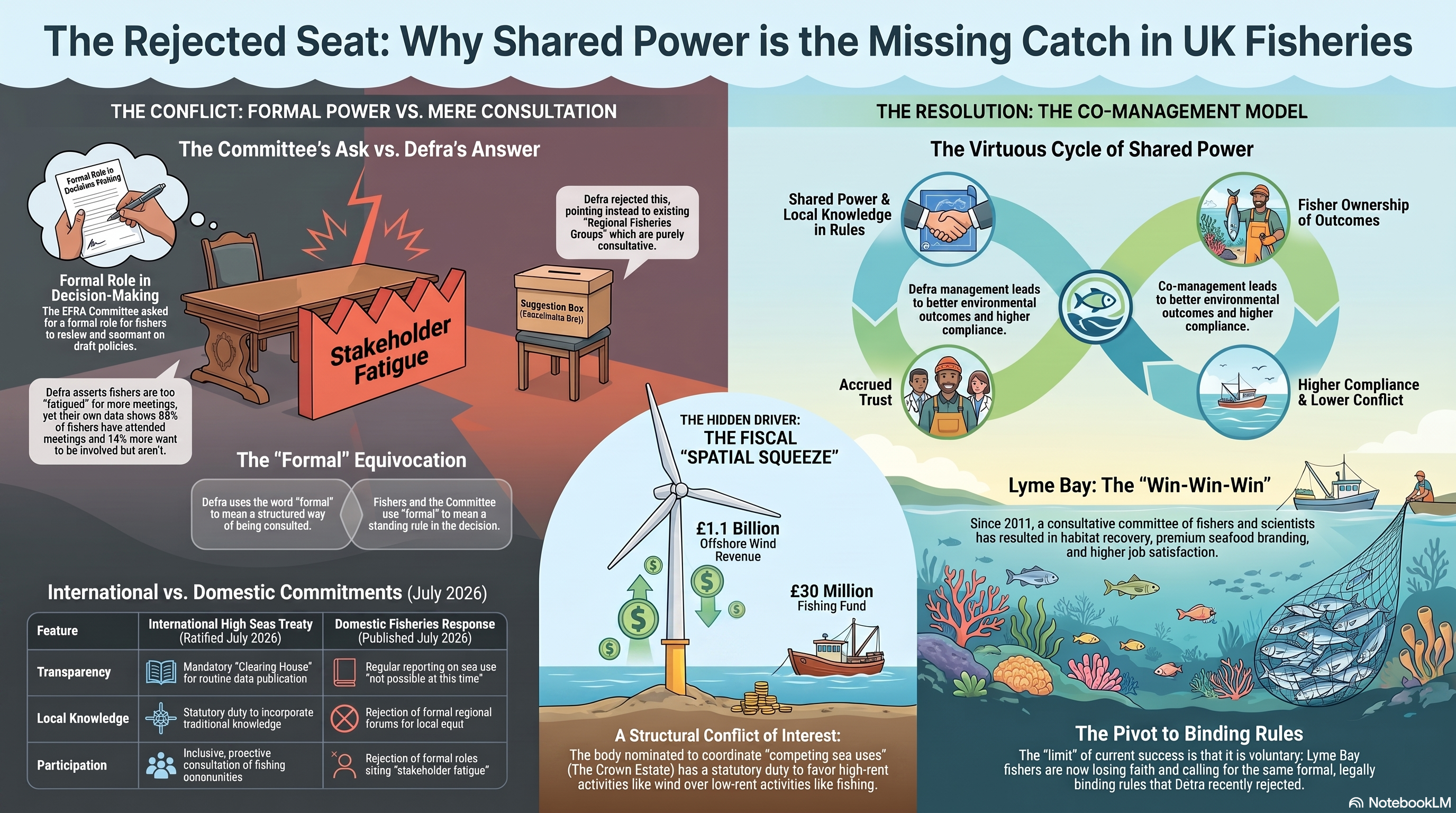
On 23 July 2026, the Department for Environment, Food and Rural Affairs published its response to Parliament. The EFRA Select Committee had asked for something clear. It recommended a national network of Regional Fisheries Management Forums. These forums would give local fishers a formal role in reviewing draft policies and technical measures.
Defra rejected the proposal.
Paragraph 24 of the government response gives the reason. The department cited increasing concerns about stakeholder fatigue.
The choice of words is revealing. Fatigue sounds like a welfare concern. It suggests a government protecting busy skippers from administrative burden.
That concern disappears when Defra wants something. The department routinely sends surveys to sixty percent of vessel owners. It runs dozens of port meetings, webinars and workshops. It logs attendance and presents high participation numbers as proof of engagement.
Fatigue is not treated as a problem when officials set the agenda. It becomes an obstacle only when fishers ask for a seat at the table.
Mike Cohen, chief executive of the National Federation of Fishermen’s Organisations, put it simply. He pointed out that mere activity is not action.
Defra’s own survey data shows that fishers are not exhausted by involvement. More than a third of English inshore skippers have never been invited into fisheries management. Fourteen percent say they want to participate but cannot.
The real issue is that consultations rarely change the outcome. Fishers attend meetings, fill out forms and then watch top-down rules arrive anyway.
The Meaning of “Formal”
Defra defended its decision by pointing to existing structures. It highlighted the Regional Fisheries Groups set up in 2021.
The official Terms of Reference for those groups tell a different story. Their stated purpose is to discuss options, evaluate techniques and make recommendations.
The groups have no decision rights. They hold no statutory standing to review draft regulations before ministers sign them. Defra is under no legal obligation to respond to their views.
The document describes the groups as a formal method of engagement.
That distinction matters. Defra uses the word formal to describe a structured consultation. The Select Committee used the word formal to mean a standing role in decision-making.
The pattern is similar across Great Britain. Scotland’s Regional Inshore Fisheries Groups are non-statutory and advisory. The only exception is the Shetland Shellfish Management Organisation, where local fishers hold legal management authority.
The EFRA Committee asked Defra to grant statutory power to English regions. Defra pointed at advisory groups and claimed the requirement was met.
It was a substitution of process for power.
What Causes Fatigue
Defra did not provide data to support its claim of stakeholder fatigue. The response contains no survey on fatigue, no metric and no evidence of falling attendance.
Instead, Defra used participation figures to infer exhaustion. Its Fishing Industry Social Survey found that 68 percent of English fishers had attended management meetings. Sixty-six percent had completed a consultation.
Defra treated high attendance as proof that fishers were near capacity. From that assumption, it concluded that formal forums would cause fatigue.
Research on public engagement points in the opposite direction. Stakeholders do not turn away because they are given responsibility. They disengage when their input produces no visible result.
When a department asks for feedback but never shows how it was used, trust erodes. A formal forum with a statutory duty on Defra to respond would fix that open loop.
Defra argued that more structure causes fatigue. The evidence suggests that lack of impact is what causes it.
Four Structural Conflicts
Four contradictions run through Defra’s policy position.
First, the statutory framework. Section 2 of the Fisheries Act 2020 required the government to publish a Joint Fisheries Statement. That document commits authorities to enhance stakeholder capacity for co-management.
Under Section 10(1) of the Act, Defra must act in accordance with that policy. Under Section 10(2), if Defra departs from it, the department must publish a statement explaining why.
The Select Committee asked Defra to deliver on its own policy. Defra declined, but it published no explanation under Section 10(2).
Second, the international timeline. On 10 July 2026, the UK ratified the UN High Seas Treaty. Article 32 requires transparent and proactive consultation with coastal communities. Article 51 mandates open publication of assessments through a global clearing-house.
Thirteen days later, Defra published its domestic response. It rejected regional forums and stated that routine reporting on domestic spatial plans was not possible at this time.
Third, the financial incentive. Defra stated that marine spatial planning is managed through initiatives linked to The Crown Estate.
Under Section 1(3) of the Crown Estate Act 1961, Commissioners have a statutory duty to maintain and enhance seabed revenue. In 2024/25, net revenue profit from offshore wind reached £1.15 billion.
Inshore fishing produces almost no seabed rent. The body coordinating sea use has a legal duty to prioritize revenue. That creates an institutional conflict of interest for small-scale fishers.
Fourth, the experience at Lyme Bay. In 2008, a trawling ban led to conflict between static gear fishers. Local crews formed a consultative committee, agreed to voluntary gear limits and restored seabed habitats.
By 2025, increased fishing pressure strained those voluntary agreements. The fishers did not ask to abandon the system. They asked the government to turn the voluntary rules into legally binding regulations.
The fishers involved in England’s main co-management site asked for formal rules. Defra cited fisher fatigue to refuse them.
The Question to Defra
The evidence from Lyme Bay shows that co-management works when fishers share responsibility. After fifteen years, those fishers are asking for statutory backing to protect their grounds.
Defra claims that formal regional forums would overburden the industry.
The department faces a clear question on its policy.
Question to Defra
“The Department claims that structured regional power-sharing would cause stakeholder fatigue among coastal fishers. At Lyme Bay, fishers who have practiced co-management for fifteen years are asking the state to make their voluntary rules legally binding.
Why does Defra cite stakeholder fatigue to block national forums when fishers with co-management experience are asking for formal structure? How does the Department reconcile this domestic refusal with the UK’s ratification of the UN High Seas Treaty thirteen days earlier?”
Defra can continue to run consultative workshops while withholding decision-making power. It can present high survey numbers as evidence of successful engagement.
The documents show that the choice to keep control in London is not about protecting fishers from fatigue. It is about where power sits.
Footnotes
[^1]: EFRA Committee Government Response, HC 550, para 24 (23 July 2026). [^2]: EFRA Committee Original Report: Resetting the relationship with fishing communities (HC 680, April 2026). [^3]: Simply Stakeholders: How to Avoid Consultation Fatigue. [^4]: Government Response to EFRA Report, HC 680, para 24. [^5]: Government Response to EFRA Report, HC 680, para 23–24. [^6]: Fishing Industry Social Survey (FISS) Data Summary, para 23. [^7]: Government Response to EFRA Report, HC 680, para 23. [^8]: i2insights: Making Engagement Effective — Closing the Loop. [^9]: Government Response to EFRA Report, HC 680, para 21–23. [^10]: Regional Fisheries Groups — Terms of Reference (June 2021). [^11]: Regional Fisheries Groups — GOV.UK Official Guidance. [^12]: APPG Fisheries: Who’s Who in UK Fisheries Management. [^13]: EFRA Committee News Release on Government Response (23 July 2026). [^14]: Regional Fisheries Groups — Terms of Reference (June 2021). [^15]: Regional Fisheries Groups — Terms of Reference (June 2021). [^16]: Government Response to EFRA Report, HC 680, para 23–24. [^17]: i2insights: Making Engagement Effective. [^18]: i2insights: Making Engagement Effective. [^19]: Government Response to EFRA Report, HC 680, para 23–24. [^20]: EFRA Committee Press Release (23 July 2026). [^21]: Government Response to EFRA Report, HC 680. [^22]: EFRA Committee Original Report: Resetting the relationship with fishing communities (HC 680, April 2026). [^23]: Fisheries Act 2020, Section 2 (Joint Fisheries Statement). [^24]: APPG Fisheries Digest: The Joint Fisheries Statement — What You Need to Know. [^25]: Government Response to EFRA Report, HC 680. [^26]: Fisheries Act 2020, Section 10 (Effect of Joint Fisheries Statement). [^27]: Fisheries Act 2020 Explanatory Notes. [^28]: FCDO Official Press Release: World’s Ocean to be Better Protected as UK Ratifies Landmark Treaty (10 July 2026). [^29]: Frontiers in Marine Science: Environmental Impact Assessment provisions under BBNJ (Art 51). [^30]: Harvard BBNJ Manager: Environmental Impact Assessment & Stakeholder Rights (Art 32). [^31]: FCDO BBNJ Ratification Press Release & Government Response to EFRA Report. [^32]: LSE Grantham Institute Explainer: What is the BBNJ Agreement?. [^33]: Government Response to EFRA Report, HC 680, para 9 & 24. [^34]: edie: UK officially ratifies landmark High Seas Treaty. [^35]: Government Response to EFRA Report, HC 680. [^36]: Government Response to EFRA Report, HC 680, para 9. [^37]: The Crown Estate: Governance and Statutory Duties. [^38]: Crown Estate Act 1961, Section 1(3). [^39]: Crown Estate Act 1961, Section 1(3). [^40]: Reuters via LSE: Britain’s Crown Estate reports profit of £1.15 billion, led by offshore wind. [^41]: Prism News: Crown Estate profit falls 13% as offshore wind revenues drop. [^42]: Crown Estate Act 1961, Section 1(3). [^43]: Crown Estate Act 1961, Section 1(3). [^44]: The Crown Estate: Governance. [^45]: The Crown Estate: £1.1 billion net revenue profit delivered for the UK. [^46]: Blue Marine Foundation: Poor Quota Management Decimating Coastal Livelihoods. [^47]: The Guardian: ‘We don’t want to be a toy town’: Has Brexit sunk this historic UK fishing fleet?. [^48]: Crown Estate Act 1961, Section 1(3). [^49]: Commonwealth Case Study: Lyme Bay Fisheries & Conservation Reserve. [^50]: Blue Marine Foundation: Lyme Bay Project Overview. [^51]: ICES Journal of Marine Science: Lessons from Lyme Bay (2024). [^52]: ZME Science: Lyme Bay was meant to be a success story, so why are fishermen losing faith in it? (Oct 2025). [^53]: ZME Science: Lyme Bay Report (Oct 2025). [^54]: ZME Science: Lyme Bay Report (Oct 2025). [^55]: ZME Science: Lyme Bay Report (Oct 2025). [^56]: ZME Science: Lyme Bay Report (Oct 2025). [^57]: ZME Science: Lyme Bay Report (Oct 2025). [^58]: ZME Science: Lyme Bay Report (Oct 2025). [^59]: ZME Science: Lyme Bay Report (Oct 2025). [^60]: EFRA Committee Original Report (HC 680, April 2026). [^61]: Government Response to EFRA Report, HC 680, para 24. [^62]: EFRA Committee News Release (23 July 2026). [^63]: ICES Journal of Marine Science: Lessons from Lyme Bay (2024). [^64]: ZME Science: Lyme Bay Report (Oct 2025). [^65]: ZME Science: Lyme Bay Report (Oct 2025). [^66]: ZME Science: Lyme Bay Report (Oct 2025). [^67]: ZME Science: Lyme Bay Report (Oct 2025). [^68]: Government Response to EFRA Report, HC 680, para 24. [^69]: ZME Science: Lyme Bay Report (Oct 2025). [^70]: Synthesis of Government Response to EFRA Report, ZME Science Lyme Bay Report, and FCDO BBNJ Press Release. [^71]: Government Response to EFRA Report, HC 680. [^72]: NFFO Press Statement & EFRA Committee News Release. [^73]: Regional Fisheries Groups — Terms of Reference (June 2021). [^74]: Government Response to EFRA Report, HC 680, para 24. [^75]: Government Response to EFRA Report, HC 680, para 24. [^76]: EFRA Committee News Release (23 July 2026). [^77]: i2insights: Making Engagement Effective.